Powered by Blogger.
Showing posts with label Financial Reform. Show all posts

Bear Stearns Anniversary

Justin Baer and Ryan Tracy have an excellent article in the Wall Street Journal commemorating the tenth anniversary of the Bear Stearns bailout.
The Federal Reserve tried to limit the damage with extraordinary actions, first extending the firm credit before forcing it into a hasty weekend shotgun marriage to JPMorgan Chase with $29 billion in assistance.
More specifically,
Ten years ago, Bear’s crisis week began with rumors of liquidity problems following steep losses from mortgage bonds. Mr. Schwartz, the CEO, phoned JPMorgan Chief Executive James Dimon to ask for a simple overnight loan. By that Thursday, Bear’s lenders and clients had backed away, and the firm was running out of cash. Mr. Schwartz called Mr. Geithner for more help.
Fearing a Bear-induced panic could spread throughout the banking system, the Fed arranged a $12.9 billion emergency loan routed through JPMorgan. It ultimately agreed to purchase $29.97 billion in toxic Bear assets.
First, Bear lost a lot of money in mortgage backed securities. Second, like Lehman to follow, Bear was mostly financing that investment with borrowed money, and short-term borrowed money at that, not with its own money, i.e. equity capital. Small losses then made it more likely Bear would not be able to pay back its debtors. Third, there was a run.  Short term creditors ran out the doors just like Jimmy Stewart's depositors in a Wonderful Life. More interestingly, Bear's broker-dealer clients started running too. Just how investment banks like Bear were using their broker-dealer clients to fund investments is a great lesson of the event.  Darrell Duffie lays this out beautifully in The failure mechanics of dealer banks and later How big banks fail.


So, if you want to stop a run, you need to convince creditors that their money is safe. Usually, you do that by issuing more equity, "recapitalization,'' But at this point, new equity holders understand that most of their money will go to pay off creditors who otherwise aren't getting anything, "debt overhang." So we need to find a source of new equity for whom the firm will be valuable enough that it's worth paying off the creditors to get it. That's the idea of one of these last minute sales to another firm, JP Morgan.

In this case, that failed too. There wasn't enough value in the firm left. It took $29 billion more to give the appearance of a buyout which would keep Bear going as part of JP Morgan, and more importantly to pay off the creditors. (That word "reacapitalization" more and more in the passive voice, tends to mean money from the government.)

Bailouts are not of the company or the management. It is all about making sure creditors get paid, so they don't run. Bailouts are always creditor bailouts.

Needless to say, this bailout did not in the end stop the financial crisis, and $29 billion would soon seem like couch change.

So, where are we now?
"Key players in the bailout, many of whom remain in finance, have spent the last decade arguing about what was done, defending decisions made then and wondering whether it could happen again. The consensus: It would be unlikely for another big firm to get into such trouble, or for the government to orchestrate such a bailout"
I found this interesting, especially the last statement. For the other universally held truth (false in my view, but I'm a tiny minority) is that letting Lehman go under was a huge mistake and led to the financial crisis. If only the Fed had saved Lehman as it did Bear, the story goes, things would not have been so bad. So why would the government not orchestrate a bailout?
"Veteran Wall Street lawyer Rodgin Cohen, who helped shape the deal for Bear Stearns, says that if a crippled firm were on the brink today, none of its peers would arrive with a rescue. “Nobody will ever again buy a severely troubled institution,” he says. “Period.”"
Many officials in Washington feel another bailout is just as unlikely. 
Why not?

The first line of defense has always been one of these arranged last-minute marriages, in which a healthier firm takes over a failing one. This will not happen again.
Nearly everyone in charge on Wall Street today, including JPMorgan’s Mr. Dimon, says they would never buy a collapsing firm like Bear.
“No, we would not do something like Bear Stearns again—in fact, I don’t think our board would let me take the call,” Mr. Dimon wrote in his 2014 letter to shareholders. “These are expensive lessons I will not forget.”
In addition to the cost of bringing the two firms together, JPMorgan was saddled with billions of dollars in legal bills and regulatory penalties. Months after the Bear deal, JPMorgan made a similar last-minute agreement to buy Washington Mutual Inc. Of JPMorgan’s nearly $19 billion in legal costs from the mortgage crisis, some 70% stemmed from Bear and WaMu, Mr. Dimon wrote.
There were many other such deals in 2008. Wells Fargo & Co. bought Wachovia Corp., Bank of America Corp. acquired Merrill Lynch & Co. and Countrywide Financial Corp., and Toronto-Dominion Bank bought Commerce Bancorp. Today, many of these Wall Street executives say they feel betrayed by the government for hitting them with penalties tied to actions by firms they were pressured to acquire.
These days, a big financial firm rescuing another would also have to consider new restrictions on risk-taking. Banks today must pass regulatory tests before paying out profits to shareholders. In that environment, executives may be more reluctant to buy assets from a desperate seller. 
Loud and clear. Over and over, the government asks a big bank to help out by taking over a failing bank, which means agreeing to pay all that failing bank's debts.  But this time, after the fact, the government made the new owners pay billions in fines for the old company's debts. Take my trash out, asks your neighbor, and you say "sure," then he calls the EPA to report on the toxic waste now in your trash barrel. Not again. And if that weren't enough, the government's own regulations will prohibit it.

So if a bailout is needed, private help won't be there.

Well, what about government help? We got $700 billion of that too last time.
Fed help like that would be illegal today. The 2010 Dodd-Frank financial-regulation law stipulates that emergency Fed lending must be “broad-based” and cannot be “established for the purpose of assisting a single and specific company.” Financial firms, like other corporations, are supposed to go bankrupt, not get bailed out.
So what is supposed to happen? "Orderly liquidation."
If regulators and the Treasury secretary assert a bankruptcy would destabilize the financial system, Dodd-Frank provides a new backstop called the Orderly Liquidation Authority. The government would take over the failing firm, wiping out shareholders. After a weekend of work by federal officials, a new company, owned by creditors of the old firm, would open Monday morning. The government would be able lend money to the new company to keep the lights on while the government sells it off in pieces.
That is supposed to prevent a panic because people who had been doing business with the failing firm would know they could continue to do so, at least for a while.
In sum, the lifejackets (shotgun marriages) and lifeboats (government bailouts), distasteful as they are, are likely gone. Speedy bankruptcy isn't here yet. We are relying on a new and untested idea, the watertight compartments.

I have long been suspicious of "orderly liquidation." The whole premise is that big banks are too complicated to go through bankruptcy court. So, the Treasury Secretary, Fed Chair and a few other officials are going to figure out who gets what over a weekend? What would you do if a big bank owed you a few billions, was on the brink, and you suspected these fine officials would be meeting this weekend to divvy up the carcass? How about run now?
What if orderly liquidation doesn’t prevent a panic? In a crisis, problems at one firm can lead investors to “run” to cut their exposures everywhere. Even healthy companies can’t get credit, damaging Main Street as badly as Wall Street. In that scenario, there may be little U.S. regulators can do on their own. Congress might be asked to reinstate the bailout authority it took away after 2008.
“Drafting big books, massive documents, having big teams—that’s all a good idea,” says Gary Parr, a longtime deal maker who advised Bear on its sale to JPMorgan. “But when you have a company get into a liquidity crunch, if things are going really fast, you don’t have time to study a book.”
The best of all worlds is one in which nobody expects a bailout, it comes once to stop a run, and then we put the moral hazard genie back in the bottle. The worst of all worlds is one in which everyone expects a bailout, but then either by legal restriction or decision it does not come. Nobody has fire extinguishers any more, and the fire house has burned down.

Where will the next crisis come from? It always comes from a new and unexpected source, so don't plan on subprime mortgages funneled through investment banks. Look instead and ask, where is there a mountain of debt that can't be paid back, a bunch of really obscure accounting, off the books credit guarantees? China's great wall of debt suggests one answer.

The other worry  " Congress might be asked to reinstate the bailout authority it took away after 2008." Yes, but even that was authority to use borrowed money. The last crisis cost us something like $5 to $10 trillion. If the US asks for that much money again, can we get it?

But all of this ignores the basic point. Financial crises are not about the failure of specific institutions. Financial crises are about runs. One way to stop runs is to convince short term creditors that no institution will ever lose money again, or that there is a big bailout ready. The other way is to fund risky investments with lots more equity. Not to beat a dead horse over and over again, but the real lesson of Bear Stearns and Lehman is what happens if you fund  risky investments with a huge amount of short term debt. That can be fixed.

(Actually, subprime mortgages aren't even very risky. Google's self driving car is way more risky. All corporate cashflows are way more risky. Why are we spending all this money policing pools of mortgages, about the safest asset there is? Answer, because they are funded by huge amounts of run-prone short-term debt.)

Tyler: Equity financed banking is possible!

Tyler Cowen wrote an extended blog post on bank leverage, regulation and economic growth on Marginal Revolution. Tyler thinks the "liquidity transformation" of banks is essential, and that we will not be able to avoid a highly levered banking system, despite the regulatory bloat this requires, and the occasional financial crisis. As blog readers may know, I disagree.

A few choice quotes from Tyler, though I encourage you to read his entire argument:
I think of the liquidity transformation of banks in terms of...Transforming otherwise somewhat illiquid activities into liquid deposits. That boosts risk-taking capacities, boosts aggregate investment, and makes depositors more liquid in real terms.  
Requiring significantly less bank leverage, at any status quo margin, probably will bring a recession. 
...many economies are stuck with the levels of leverage they have, for better or worse. 
I fear ... that we will have to rely on the LOLR function more and more often. 
I don’t find the idea of 40% capital requirements, combined with an absolute minimum of regulation, absurd on the face of it. But I don’t see how we can get there, even for the future generations.
Depressing words for a libertarian, usually optimistic about markets.

This is a good context to briefly summarize why "narrow", or (my preferred) equity-financed banking is in fact reasonable, and could happen relatively quickly.

Tyler's main concern is that people need a lot of "liquidity" -- think money-like bank accounts -- and that unless banks can issue a lot of deposits, backed by mortgages and similar assets, bad things will happen -- people won't have the "liquidity" they need, and businesses can't get the investment they need.

Here are a few capsule counter arguments.  In particular, they are reasons why the economy of, say 1935 or even 1965 might have required highly levered banks, but we do not.

1) We're awash in government debt.


We've got about $20 trillion of government debt. That could back about $20 trillion of risk free assets. (It would be better still if the Treasury would issue fixed-value floating-rate debt, needing no intermediation at all.) Add agency debt -- backed by mortgage backed securities that are already guaranteed by the Treasury -- and you have another $8 trillion. Checking accounts are about $1.5 trillion and total bank liabilities about $9 trillion.

In the past, we may have needed to create money-like deposits by backing them with bank assets. A happy side to our debt expansion is that government debt -- the present value of the governments' taxing authority -- provides ample assets to back all the money-like deposits you want.

2) Liquidity no longer requires run-prone assets. Floating value assets are now perfectly liquid 

In the past, the only way that a security could be "liquid" is if it promised a fixed payment. You couldn't walk in to a drugstore in 1935, or 1965, and trade an S&P500 index share for a candy bar.  Now you can. (And as soon as it is cleared by blockchain, it will be even faster and cheaper than credit cards.) There is no reason your debit card cannot be linked to an asset whose value floats over time.

This is the key distinction. The problem with short term debt is that it is prone to runs. Financial crises are runs, period.  Short term debt is prone to runs because it promises a fixed amount ($1), any time, first come first serve, and if the institution does not honor the claim it is bankrupt.

Seriously. Imagine that your debit card was linked to an ETF that held long-only, full allocations (not risky tranches) of high grade mortgage backed securities. Its value would float, but not a lot. Bank assets are, curiously immensely safe. So it might go up or down 2% a year. In return you get a higher interest rate than on pure short-term government debt (of which there is $28 trillion under my scheme).  You would hardly notice. Yet the financial system is now immune from runs!

3) Leverage of the banking system need not be leverage in the banking system. 

Suppose even this isn't enough and we still need more risk free assets. OK, let's lever up bank assets. But why should that leverage be in the bank. Let the banks issue 100% equity. Then, let most of that equity be held by a mutual fund, ETF, or bank holding company, and let those issue deposits, long term debt, and a small amount of additional equity. Now I have "transformed" risky assets into riskfree debt via leverage. But the leverage is outside the bank. If the bank loses money, the mutual fund, ETF, or holding company fails... in about 5 minutes. The creditors get traded equity of the bank, which is still at 90% of its initial value. There is no reason bank creditors should dismember a bank, go after complex and illiquid bank assets, stop operation of the bank. If bank assets must be leveraged, put that leverage outside the bank.

And, if you need even more leverage, well, these leveraged ETF can hold other assets too. There is no reason not to leverage up stock, corporate bonds, REITS, mortgage backed securities or other assets if we desperately need to provide a riskfree tranche. We don't see this. Why not? Maybe "riskfree" assets aren't so important after all!

Tyler sort of acknowledges this, but with fear rather than excitement:
But what if a demand deposit is no longer so well-defined? What about money market funds? Repurchase agreements? Derivatives and other synthetic positions? Guaranteeing demand deposits is a weaker and weaker protection for the aggregate, as indeed we learned in 2008. The Ricardo Hausmann position is to extend the governmental guarantees to as many areas as possible, but that makes me deeply nervous. Not only is this fiscally dangerous, I also think it would lead to stifling regulation being applied too broadly. 
A lot of commercial bank leverage can be replaced by leverage from other sources, many less regulated or less “establishment.” Overall, on current and recent margins I prefer to keep leverage in the commercial banking sector, compared to the relevant alternatives....One big problem with attempts to radically restrict bank leverage is that they simply shift leverage into other parts of the economy, possibly in more dangerous forms...
Absolutely. In my view nobody should issue large quantities of run-prone assets -- fixed value, immediate demandability, first come first serve -- unless backed by government debt. However, we should cherish the rise of fintech that allows us to have liquidity without run-prone assets. And don't fear even leverage outside commercial banks without thinking about it. My ETF, whose assets are common stock, and liabilities are say 40% "deposits", 40% long-term debt, and 20% equity, really could be recapitalized in 5 minutes, without any of the adverse consequences of dragging a bank through bankruptcy court.

4) Inadequate funds for investment I'm not quite sure where Tyler gets the view that without lots of unbacked deposits, funds for investment will be scarce -- just how leverage
boosts risk-taking capacities, boosts aggregate investment,...
Requiring significantly less bank leverage, at any status quo margin, probably will bring a recession. 
The equity of 100% equity financed banks would be incredibly safe. 1/10 the volatility of current banks. It would be an attractive asset. The private sector really does not have to hold any more risk or provide any more money to an equity financed banking system. We just slice the pizza differently. If issuing equity is hard, banks can just retain profits for a decade or so.

Or, better, our regulators could leave the banks alone and allow on on-ramp. Start a new "bank" with 50% or more equity? Sure, you're exempt from all regulation.

And, in case you forgot, we live in the era of minuscule interest rates -- negative in parts of the world; and sky high equity valuations. All the macroeconomic prognosticators are still bemoaning a "savings glut." A scarcity of investment capital, needing some sort of fine pizza slicing to make sure just the right person gets the mushroom and the right person gets the pepperoni does not seem the key to growth right now.

Update: Anonymous below asks a good question: "What about payrolls, debiting and crediting exports and foreign transactions, escrows."  And I could add, accounts receivable, trade credit and so forth.

Answer: We need to eliminate large-scale financing by run-prone securities. Not all debt is run prone. It needs to be very short term, demandable, failure to pay instantly leads to bankruptcy, and first come first serve. And it has to be enough of the institution's overall financing that a run can cause failure. An IOU for a bar bill -- pay for my beer, I'll catch up with you next week -- is a fixed-value security, yes. But it is not run prone. You can't demand payment instantly, bankrupt me if I don't pay, I have the right to postpone payment,  it's not first come first serve, and such debts are a tiny fraction of my net worth.

Update: A correspondent writes
[Equity financed banking] Already exists! Albeit not at scale yet. It’s called asset management. See, for example, Alcentra, a UK-based company that lends directly to mid-sized European companies. They are largely “equity financed,” meaning that they sell shares in their funds, mostly to institutional investors. They also offer separate accounts, which you can also think of as “equity financing.” They are not a bank, but an asset manager, taking advantage of reduced lending since the crisis by banks to mid-sized and low credit firms in Europe. They have about 30 billion in AUM. This is a “disintermediation” story no one is talking about, and direct lending by asset managers is on the rise more broadly as well.


Cowen on Fed Chair

Tyler Cowen has a good thought on the Fed chair question. The next chair has to be a good politician, in all the positive senses of that word, more than a good technocrat:
The Fed has functioned as a technocracy for a long time, but might the future bring a Fed that is irrevocably split between competing factions? ...the future could bring a Fed divided over how much it should assert its political independence, how much it should assume responsibility for possible asset bubbles, how it should respond to an international financial crisis, or how much it should align with an “America First” mindset. .... 
The backdrop is this: Ben Bernanke’s Fed, with its bailouts during the financial crisis, ate up a lot of the Fed’s political capital, though arguably for the worthwhile cause of saving the financial system. As a result, the Fed no longer has its pre-crisis credibility. As long as the American economy is on the path of a slow and steady recovery, with relatively high asset prices, that’s bearable. 
But the next time major economic volatility comes around, Fed decisions will be scrutinized and politicized like never before. This will happen in the mainstream media, on social media, and perhaps by our very own president in his tweets or offhand remarks. The key factor for any Fed leader will be the ability to maintain and project a coherent, unified voice at the Fed, so that the Fed remains an island of relative sanity in the polarized nation. This will be a problem of crisis management, but unlike Bernanke’s crisis management it will be fought first and foremost in the trenches of public opinion.
(The open vice chair positions are good ones for technocrats, who need to be able to translate the abstruse language of the staff.)

My related thought: We focus a lot on interest rate policy, but most of what the Fed does these days is financial regulation and supervision, and those decisions are likely much more important going forward.  The challenging question there is "macro-prudential." Is it the Fed's job to worry about "asset bubbles," and to micromanage "credit booms" and their eventual busts? Or is it better for the Fed to limit its authority, to preserve independence, credibility, and insulation from political demands for action and political criticism of its actions, by pronouncing there are economic events beyond its scope?

Moreover, if the Fed is to limit the scope of its financial dirigisme, it had better do so beforehand not afterwards. If everyone expects the Fed to set prices and bail out hither and yon, and then the Fed gets religion (perhaps under relentless political pressure), the crisis will be so much worse. Bernanke also benefitted from acting far beyond expectations of what he would or could do. The next chair will be in the opposite situation, have to set limits of crisis reaction, and disappoint expectations. It's much better to do that ahead of time -- and much harder for an institution like the Fed to scale back people's expectations, and to renounce and pre-commit against attractive-sounding powers.

Update: 

Narayana Kocherlakota predicts Jerome Powell. In line with some of the above thoughts, Narayana's view basically is that monetary policy is doing fine. Low unemployment, low inflation, low interest rates, low macro and financial volatility. Mission accomplished. Moreover, if there is a hawk vs. dove question, President Trump looks likely to be on the dove side of it. (Sadly, I doubt that rules and precommitment vs. discretion is ringing in the appointment decision.) However, supervision and regulation is the key issue going forward, and Narayana views Powell as Yellen monetary policy plus a regulatory/supervisory reform.

(I learned to use both words from Ms. Yellen's Jackson hole speech. Regulation is rules, supervision is sending Fed people to look over banks' shoulders. It's a good distinction.)

Yellen at Jackson Hole

Fed Chair Janet Yellen gave a thoughtful speech at the Jackson Hole conference.

The choice of topic, financial stability and the Fed's role in financial regulation and supervision, says a lot. Financial regulation, supervision, and other tinkering, is much more centrally a part of what the Fed is and does these days than standard monetary policy. Whether overnight interest rates go up or down a quarter of a percentage point may be the subject with the greatest ratio of talk to action, and of commentary to actual effect, in all of economics. Interest rates are likely to stay around 1% for the foreseeable future. Get used to it. But the Fed is deeply involved in running the financial system, and all the talk points to more. 

Rather unsurprisingly, she did not give the speech I might have given, or that some of the others campaigning for her job have given, bemoaning the current state of affairs. She's been in charge, after all. If she viewed the Dodd-Frank act as a grossly complex Rube Goldberg contraption, and the Fed only following silly rule-making dictates to comply with the law, she would have said so loudly long before this. Whether with an eye to reappointment, to write the first draft of history, or -- my sense of Ms. Yellen -- out of forthright Jon Snow-like irrepressible honesty, one should not have expected a stunning critique.  Moreover, her speech is dead-center of the world in which she lives, that of international policy and regulatory organizations. It would be a lot to expect a Fed chair to lead intellectually and to strike out far from the consensus of the bubble.

Still, I am disappointed. Even accepting her view of the crisis, and the current slow growth era, there are far more "Remaining Challenges" than her three paragraphs. There are far more questions to be asked, paths to choose, and fundamental choices to be made.

Which deregulation? 

The call to roll back our regulatory structure can be read two ways: 1) Reduce the insanely complex rules, and the even more intrusive discretionary supervisory regime, and replace it with even higher capital standards. 2) Reduce capital and leverage ratios, keep the lovely anti-competitive complex rules in place, slowly capture the discretionary regulators, keep the wink-wink bailout regime in place, risk on, dividends out. (An earlier post on the Trump executive order on financial regulation.)

You can guess which one I favor. I sense Ms. Yellen is mostly pushing back on the second, especially the desire by big banks for less capital and more trading freedom. But aside from
"There may be benefits to simplifying aspects of the Volcker rule... and to reviewing the interaction of the enhanced supplementary leverage ratio with risk-based capital requirements, " 
she concludes that
"any adjustments to the regulatory framework should be modest,"   
which sounds like a rather uncritical defense of everything put in place. Really? Is every provision of the Dodd-Frank act wise? Is there no room, after 10 years, and a lot of experience, for a thoughtful retrospective evaluation and revision of the tens of thousands of pages of rules?

Safer? 

The most important question, really: Is the system in fact safer, more "resilient," ready to deal with the next crisis, especially if that crisis comes from a new source -- say pensions, student debt, or worst of all, a global sovereign debt crisis?

Ms. Yellen asserts, that yes:
"reforms have boosted the resilience of the financial system. Banks are safer. The risk of runs owing to maturity transformation is reduced. Efforts to enhance the resolvability of systemic firms have promoted market discipline and reduced the problem of too-big-to-fail. And a system is in place to more effectively monitor and address risks that arise outside the regulatory perimeter."
Really? How and why?
"Loss-absorbing capacity among the largest banks is significantly higher, with Tier 1 common equity capital more than doubling from early 2009 to now. The annual stress-testing exercises in recent years have led to improvements in the capital positions and risk-management processes among participating banks. Large banks have cut their reliance on short-term wholesale funding essentially in half and hold significantly more high-quality, liquid assets."
."..Economic research provides further support for the notion that reforms have made the system safer. Studies have demonstrated that higher levels of bank capital mitigate the risk and adverse effects of financial crises. Moreover, researchers have highlighted how liquidity regulation supports financial stability by complementing capital regulation."
Yes!  Capital, capital, capital, and the more the merrier. But we don't need ten thousand pages of regulations, nor annual stress tests to just demand more capital. Moreover, just how much capital, and how measured? That alone could have made a good, and quite long, speech.

The rest is less encouraging:
Assets under management at prime institutional money market funds that proved susceptible to runs in the crisis have decreased substantially. 
That assets under management have decreased is not a good sign. Money market funds are easy to fix -- float NAV, change to ETF structure, or add equity cushions. Capital and fixing run-prone liability structures substitutes for intrusive asset regulation, a point that seems to be missed entirely.
"Credit default swaps for the large banks also suggest that market participants assign a low probability to the distress of a large U.S. banking firm." 
CDS tell us about the probability of an imminent crisis, not about the resilience of banks if one should come.

As the Wall Street Journal notes compactly in response to Ms. Yellen's overall claim of safety
"Banks are safer, but they should be after eight years of modest expansion. The real test of financial stability comes in times of economic stress, when interest rates rise or investors get nervous and rush to safer assets."  
Ms. Yellen recognizes the narrow point,
"To be sure, market-based measures may not reflect true risks--they certainly did not in the mid-2000s--and hence the observed improvements should not be overemphasized."
But not, I think, the larger point. All the banks looked perfectly safe to everyone who was looking in 2006, including the Fed. Yes,
 "supervisory metrics are not perfect, either."
The big banks passed their regulatory standards through the crisis. So did Lehman Brothers. Ms. Yellen concludes only that
"policymakers and investors should continue to monitor a range of supervisory and market-based indicators of financial system resilience."
Pay attention to a lot of signals none of which indicated the last crisis? And then do what? As the WSJ put it,
"You have to ignore history to believe that regulators are suddenly so wise that they know the current regulatory regime will prevent the next crisis. ... Fed officials Ben Bernanke and Tim Geithner then underestimated the financial risks in early 2008 when the stresses were already apparent."
Ms. Yellen herself, in another context, recognizes the fact
And yet the discussion here at Jackson Hole in August 2007, with a few notable exceptions, was fairly optimistic about the possible economic fallout from the stresses apparent in the financial system.
In a nutshell, just how much better is Ms. Yellen's feeling that the banking system is safe than was Mr. Bernanke's in 2007, and on what basis?  More deeply, what justifies her faith, reflecting that in all the regulatory community, that this time, "policymakers" by monitoring "a range of supervisory and market-based indicators of financial system resilience" will see the crisis coming, and do something about it? Shouldn't the screaming lesson of the last crisis be, that we need a resilient system, not clairvoyant "policymakers" (I hate that word) "monitoring" and by implication guiding, the system?

Regulation vs. supervision

That is another huge question going forward -- what is the emphasis on regulation vs. supervision? On rules vs. discretion? On process vs. outcome?

Most people just use "regulation" to mean both things, but the nature of regulation is one of the central issues. Does the Fed set rules of the game, or does the Fed actively tell banks what to do? And is the Fed's "systemic" effort best spent on rules -- more capital -- or on efforts to improve its clairvoyance, see crises before they happen, to monitor the decisions of individual banks and actively take action?

An analogy: The highway patrol, DMV, and department of transportation are in charge of highway safety. By and large they set rules -- drive 55 mph here, and 35 mph there; stop at red lights; freeway lane markers must look so and so. They do not ask, "submit your plan to drive to LA for approval," nor do they put an employee in the back seat to tell you it's time to pull over and rest, as the Fed has over a hundred employees embedded in each big bank. We tend to call both activities "regulation," but "supervision" is a better polite word for the latter. There are many impolite words.

So, the big question: Is the Fed's job to set up stable rules of the game, standards like capital, so that the system is "resilient" on its own? Is it in charge of the fire code, and how many sprinklers and extinguishers are in each house? Or is the Fed's job to be the fire department, spotting fires as they break out, rushing to the rescue, and sending its employees to watch over how you cook dinner?

The view that next time, they will really see it coming, and do something about it, pervades this speech. A small example is faith in the "resolution authority."
"the ability of regulators to resolve a large institution has improved, reflecting both new authorities and tangible steps taken by institutions to adjust their organizational and capital structure in a manner that enhances their resolvability and significantly reduces the problem of too-big-to-fail.
To my mind, the idea that the Fed chair and Treasury secretary will quickly and painlessly "resolve" a big bank, that owes a lot of other big banks money, and that is too complex for bankruptcy court to handle, in the panicked environment of a developing crisis,  without a big creditor bailout, is a pipe dream. Really? If you had resolution authority, you would have closed Citi and AIG, forcing losses on creditors?

The Wall Street Journal agrees with the general rules vs. discretion view:
"That’s one reason to support a financial regime with high levels of capital to defend against potential losses but with less regulatory micro-managing."
More deeply, it charges
"Fed officials are launching a political campaign to retain their vast discretionary control over the American financial system."   
I think that's a bit harsh and unduly conspiratorial. The government and chattering classes pretty much asked the Fed to become the great financial dirigiste, the Fed fills the role uncomplainingly. One slips into discretionary financial dirigisme naturally and slowly. Fed officials live largely in an international bubble of self-described "policy makers", where the idea that central banks should actively direct all facets of the financial system is just taken for granted. But however one views the motivation, the outcome is the same.

Macro-Prudential Policy

This buzzword really captures that big question going forward. Interest rates will be stuck low for a while, and appear increasingly ineffective. Central banks are the giant discretionary financial regulator, making little distinction between sit-back-and-make-rules vs. decree actions and outcomes. Surely, then, regulation, supervision, and policy activities should merge. When a little "stimulus" is needed, just tell banks to lend, or push up some asset prices. If a "bubble" is diagnosed, tell them to cut back, tighten regulations, sell some assets.

A tiny but revealing item on this agenda came my way last month at the excellent Stanford SITE conference. (I hope to review some of the other papers later.) This little story helps to explain the mindset in the bubble, and how one does not need to see politicization to see how the Fed slips in to financial dirigisme. Marco DiMaggio presented "How QE works: Evidence on the Refinancing Channel." (Paper with  Christopher Palmer and Amir Kerman). They found that when the Fed purchased mortgage-backed securities in QE, that funded lots of cash-out mortgage refinancing, and then people spent the money. Stimulus!

OK, that seems like a reasonable though unanticipated effect of the policy. Then, their policy conclusions: 
Overall, our results imply that central banks could most effectively provide unconventional monetary stimulus by supporting the origination of debt that would not be originated otherwise. 
...it appears preferable for LSAPs to purchase MBS directly instead of Treasuries during times when banks are reluctant to lend on their own. Related, central-bank interventions could be more effective by providing more direct funding to banks for lending to small business and households.
You see the natural progression. A financial market intervention by the Fed has an effect on the economy. Ergo, the Fed should get ready to use it next time. FOMC discussions previously about the path of interest rates now should include "if we buy some MBS, we can get people to cash out refi, and buy new cars."

I don't mean to pick on Marco and coauthors. This is one sentence of an otherwise excellent paper. Had they written "could" instead of "should" I would have no objection. Their paper is not about constitutional questions of central banking!

 My point: this kind of thinking pervades the policy-maker bubble. Hundreds and hundreds of papers find that the central bank can affect this or that by buying securities, changing bank regulations, changing financial regulations. They, and conference participants, segue into "policy conclusions" that central banks should use this dandy new tool. Practically nobody stops to ask, just because the central bank can affect the economy through its regulatory or asset purchase powers, should it do so?  The question, "do we really want an independent central bank routinely dialing up and down levers of cash-out refinancing, with an eye to raising or lowering stimulus" just never occurs to anyone.

That constitutional question is the big one we all should be asking as central banks move to financial regulation and discretionary supervision. Ms. Yellen could have asked it. We seem to have this new power to direct the financial system. Do you really want us to use it? She did not. That's not surprising. Essentially nobody inside the central banking bubble asks this question. It's not "political" in the WSJ sense, though any large discretionary power will soon be politicized. (Many central banks around the world allocate credit to politically popular constituencies.)

What's systemic anyway? 

Just what is a "systemic" crisis anyway? That would seem to be a foundational question that a Fed chair should weigh in on, and Ms. Yellen writes (as usual for the policy-maker world) as if we all knew exactly what it is. Yet the answer is decidedly muddy.

It bears on policy. For example. right now, there is a movement around the world to declare that asset managers are systemic dangers. How is that possible? The manager buys and sells your stocks. If he or she invests in a stock and it goes down, you can't demand your money back; you can't run, you can't force the manager into bankruptcy. Shouldn't asset managers get a non-systemic gold star, for not issuing run-prone securities? Well, the story goes, they might "herd" or be prone to "behavioral biases," and, heaven forbid, sell stocks, which  might go down.  I guess, and a hyper-leveraged bank might get in trouble (despite all of Ms. Yellen's assurances)?  "Financial stability" now seems to mean nobody should ever sell anything and stocks should never go down. Except we want lots of "liquidity" so people can sell things fast (to who?) in a crisis...The intellectual quicksand is rising fast.

Are insurance companies "systemic?" Are retirement plans "systemic?" Just who gets saved when?

What is a crisis anyway? Is it just a bunch of bankruptcies? What is the nature of "contagion?" Is it dominoes -- A fails, A owes B money, B fails? Is it (my view) a run -- A fails, so people question B and pull out run-prone assets? The system seems to handle even big bankruptcies fine at sometimes, and not at others. What makes those times different? How do you "resolve" in a crisis?

Ms. Yellen points to "liquidity" being a problem in a crisis, and her Fed now encourages institutions to have lots of "liquid" assets to sell in the event of losses. But to who? Isn't there something deeply wrong about a system in which everyone's risk management plan is to sell assets in the event of price declines?

Ms. Yellen's account of the crisis, though a nice capsule history, is not at all insightful on this point. She speaks of "liquidity" and "solvency" and "vulnerabilities." But moving from  what happened to  why, she writes only a familiar story of behavioral excess -- much of it, curiously, squarely blaming past central bankers, though cloaked in passive voice -- with no mention of mechanics. Yet her job is to fix the machine, not to wish for smarter people
"Financial institutions had assumed too much risk, especially related to the housing market, through mortgage lending standards that were far too lax and contributed to substantial overborrowing. Repeating a familiar pattern, the "madness of crowds" had contributed to a bubble, in which investors and households expected rapid appreciation in house prices. The long period of economic stability beginning in the 1980s had led to complacency about potential risks, and the buildup of risk was not widely recognized. As a result, market and supervisory discipline was lacking, and financial institutions were allowed to take on high levels of leverage. This leverage was facilitated by short-term wholesale borrowing, owing in part to market-based vehicles, such as money market mutual funds and asset-backed commercial paper programs that allowed the rapid expansion of liquidity transformation outside of the regulated depository sector. Finally, a self-reinforcing loop developed, in which all of the factors I have just cited intensified as investors sought ways to gain exposure to the rising prices of assets linked to housing and the financial sector. As a result, securitization and the development of complex derivatives products distributed risk across institutions in ways that were opaque and ultimately destabilizing."
That's not an encouragingly insightful description of what's wrong with the machine. And when you read it, if it's all "madness of crowds", including (admirably) madness of regulators, there is absolutely nothing in the new regime to stop it from happening again.

A last nice word. 

If Ms. Yellen is not reappointed, will her successor do better? Well, that depends who it is, of course, but parts of the speech show just how high that bar will be.

The speech is detailed, and knowledgeable. In most of her points, Ms. Yellen makes deep contact with academic literature, much of it conducted at the Fed. As our leaders consider whether she should continue or who and what kind of person should replace her, this is worth keeping in mind. A banker or professional policy type is unlikely to be able to assimilate this wide resource thoughtfully and critically. 

Now, academic economics doesn't have a great popular image these days, and you may react, "so much the better if our next Fed chair doesn't listen to a bunch of pointy-headed geeks." I think the pointy-headed geeks have got a lot of things wrong too, and tend to write papers that please the upper echelons. I disagree with much of the literature she cites. But this is the expertise we have. A thousand well-trained minds thinking about the issues, and absorbing the facts we have, is better than none.

While we may wish for a Fed chair, or a president, or any other leader, with a great "gut instinct" and "experience," the history of the Fed shows that just about every major disaster has been one of wrong gut instincts and misleading experience. America works with great institutions that guide imperfect and sometimes mediocre people, not by hoping for wiser aristocrats.

Moreover, Ms. Yellen knows to be skeptical. When staff come in with a model or regression that shows this or that, she knows where the bodies are buried.  Though I have made fun of the academic-policy-maker bubble, someone too far outside of the bubble will either be bamboozled by the BS or unaware of the wisdom. Neither is good. 

Good bankers know how to run banks, but not a banking system. Things that are great for a bank -- more leverage, less competition,  more bailouts -- are not so good for a banking system. Good political appointees know about politics and policy, but are not likely to answer my questions with any more clarity, and also to be befuddled by the confusing issues. Yes, economists don't understand "systemic" and "liquidity" and "contagion" very well. But practitioners, even those who know how to make money on them, understand their mechanisms even less.

A good Fed chair needs a deep, yet skeptical knowledge of Ms. Yellen's footnotes, together with lessons of experience, a deep knowledge of financial and economic history, and now an understanding of financial economics and the economic, legal, and institutional architecture of the financial system, along with the ability to run a sprawling institution, political acumen, and that ineffable characteristic, wisdom. 


Pollyanna

In case you stay up at night worrying about the next financial crisis, the good folks at the Financial Stability Board have produced a nice soothing little video (original link in case the embed doesn't work, and so you can see that no, I'm not making this up),


The short summary:

Safer, Simpler, Fairer 
3 July 2017 
A decade on since the start of the global financial crisis, G20 countries have rebuilt the financial system so that it serves society, not the other way round. 
By fixing the fault lines that caused the crisis, the financial system is now safer, simpler and fairer than before.   
View and share our videos that explain the G20's work to reform the financial system.
As cheery propaganda, it's not quite up to the Chinese "belt and road" video standard, but pretty good. It needs more puppies and singing children. As unintentional humor, it scores highly. I mean, wasn't "safer" enough, questionable as it is? Did they really have to stretch for simpler and fairer? I don't think Dodd and Frank themselves buy that one.  As a good link to have around for the next financial crisis, better still. As an insight into the wisdom of the Financial Stability Board... well, sometimes I find things that leave even me sputtering to find a pithy summary. You'll have to enjoy it on your own, and try to come up with something good in the comments.

Update: Look at the "capital" bucket. What capital ratio is in the video? What capital ratio is in real life?

Living Trusts for Banking

One of the core problems of financial reform is how to "resolve," AKA bankrupt, a big bank -- how can equity holders be wiped out, and debt holders carve up the remaining assets. Big banks are supposed to craft “living wills,” really living vivisection guides, but that effort is clearly in trouble. This blog post expands on a different idea for bank resolution; let’s call it “living trusts” by a similar analogy to estates.


Here's the idea: Let a bank fund its risky investments 100% by issuing equity. The bank then simply cannot fail — it cannot go bankrupt, it cannot suffer a run.  As I've argued elsewhere, I think this is entirely practical.

But suppose it really is important for some reason to carve up bank liabilities into a small amount of highly leveraged equity and a large amount of run-prone short-term debt. Suppose it really is important for banks to "create money," and to take deposits, and to funnel those into risky, illiquid, and otherwise hard-to-resolve assets. Suppose that equity holders really demand highly leveraged high return high risk bank equity, not super-safe low return low risk bank equity, that the return on equity not its Sharpe ratio is a constant of nature.

OK. For $100 of assets, and $100 of bank equity, let, say, $10 of that equity be traded — enough to establish a liquid market. Then, let $90 of that equity is held by a downstream entity or entities— a fund, special purpose vehicle, holding company or other money bucket. I’ll call it a holding company, and return to legal structures below. The holding company, in turn, issues $10 of holding company equity and $80 of debt.

There you have it — $100 of bank assets are “transformed” into $10 of very safe bank equity, $10 of risky and high return holding-company equity, and $80 of short-term debt.

Now if the bank loses money, the value of the bank equity falls. But the bank is failure-proof and run-proof. Shareholders get mad, may throw out management, may even break up the company. But they cannot run, demand their money now, and force bankruptcy.

The holding company can fail however! Suppose he bank loses $20. The holding company owes $80 of short term debt. Its assets are worth .9 x $80 = $72. It’s insolvent. It fails. Holding-company equity holders are wiped out. Holding-company creditors get the assets, common stock in the original bank, worth $72/$80 = 90 cents on their original dollar.

It need not be that drastic. Its likely the previous short-term debt holders don’t want stock, and would want to sell it in a hurry. Dumping 90 shares on the market might be tough.

The holding company could do a 5-minute recapitalization instead. Holders of the $80 of debt get $60 of debt and $12 of new holding-company equity. The holding company is recapitalized by the flip of a switch.

The key: this resolution/recapitalization can happen in about 5 minutes.


It takes no lawyers, no bankruptcy court, no resolution authority, no FDIC, no deep pocketed buyer, no deal sweeteners and toxic asset subsidies from the Fed, no months in court trying to find rehypothecated securities in foreign branches.  The bank itself keeps humming along. There is no interruption in lending activity, no risk that the ATM machines go dark. There is no run by depositors, brokerage clients, derivatives counterparties. There is no destruction of bank human capital.

The holding company assets—common stock in the bank — are completely transparent. They are liquid, and marked to market instantaneously. They can be handed to creditors at the flip of a switch. There is no tension between "illiquidity" and "insolvency," no "impaired assets." We know what the holding company is worth on a millisecond basis.  There is no "contagion," in which failure of one bank holding company leads people to question another, because everyone knows what the holding company is worth at all times. We don't need any regulators or accountants to flip any switches -- the second the market value of holding company equity falls below a given threshold, the failure or recapitalization happens instantly. Electronically.

As a reminder, here is how banks are organized now. In the event of bankruptcy or a run, the large amount of debt has a direct claim on the bank's assets. To realize that claim, though, they have to go through bankruptcy court or the resolution authority, and then sell actual assets. Assets are illiquid, hard to sell, especially in a crisis. This takes years and a lot of lawyer fees. Meanwhile the bank operations are often frozen, and its ability to serve customers and make loans is impaired, so the economy suffers.

Current regulation includes “living wills” that are supposed to make it easy to tear up a bank quickly, but there is a lot of doubt that will work. The Dodd- Frank "Resolution authority" is supposed to step in as the FDIC does, to quickly force a resolution before too much value is lost. But the idea that a few government officials can do over a weekend what bankruptcy court cannot accomplish in months seems weak, at best.
The living will idea has not been a huge success, with the Fed flunking several banks’ proposals. More deeply, the idea that in the midst of the next crisis — imagine early October 2008 — our government really will step in to a troubled big bank — Citi, say — and force big losses on the other creditors, each screaming their own "systemic importance" seems questionable.

I won't here belabor the options, but there are lots of ways to organize the same basic idea. I originally thought of the holding company as a mutual fund, exchange traded fund, or special purpose vehicle, to emphasize how mechanical the whole thing is. Now, I like the idea of a holding company a bit better, as equity also has voting and control rights. But this post is about finance and not law, and I'm not that good at corporate finance or law anyway. So fill the box any way you'd like.

"Holding company" is attractive though because many banks are already organized around a large holding company which effectively owns shares in multiple banks. So really all we're doing here is cleaning up the relationship between holding company and banks, and who has rights to what claims on either.

The central point: Debt, and especially short term debt, is a liability of the holding company not a liability of the original bank. Its rights are limited to recovering common stock of the bank. As stockholders, its owners can choose to liquidate the company if they choose. But they do not have the right to seize bank assets directly.

Clearly, having gone this far, the holding company could be diversified, and perhaps interleaved -- one holding company holds shares in several banks, and each bank could issue equity to multiple holding companies -- or leveraged bank-stock ETFs, which is what they become. Such diversification would make the debt even safer.

The idea has some parallel with cocos -- convertible bonds. The idea there is to issue bonds that trigger conversion to equity under certain conditions. The trouble is just what are those conditions. You need accountants or regulators to peer into notoriously obscure bank balance sheets and decide to trigger the conversion. With the holding company structure, the market price of bank shares does that for you.

What objections remain? Yes, the deposits and short term debt I describe are not perfectly risk free. Diversified holding companies would help. Capital ratios on holding companies would help. Partial funding with long-term debt, as with current banks, would help. But the current structure is not risk free either (!), absent a government guarantee.  In fact, the risk is a good deal smaller, even at the same capital ratios, because this system pretty much eliminates runs and crises. There is no uncertainty about the holding company's status.

The other possibility is that short term debt, with a bankruptcy court claim on assets, is somehow deeply tied to the bank's investment or loan origination activity. Lots of people make such a claim, perhaps that run-prone debt is needed to discipline bank managers in a way that closely-held equity cannot do. If there is such a tie, however, it is severed by government deposit insurance, guarantees, and resolution, so we're not making progress as things are.

(Some of these thoughts are prompted by "Bank Resolution and the Structure of Global Banks" by  Patrick Bolton Martin Oehmke, which Martin recently presented at Stanford. They study a similar issue of where and how regulators restructure banks.)

Fintech and Shadow Banks

"Fintech, Regulatory Arbitrage, and the Rise of Shadow Banks" is an interesting new paper by  Greg Buchak, Gregor Matvos, Tomasz Piskorski, and Amit Seru

1. Shadow banks and fintech have grown a lot.
the market share of shadow banks in the mortgage market has nearly tripled from 14% to 38% from 2007-2015. In the Federal Housing Administration (FHA) mortgage market, which serves less creditworthy borrowers, the market share of shadow banks increased...from 20% to 75% of the market. In the mortgage market, “fintech” lenders, have increased their market share from about 5% to 15% in conforming mortgages and to 20% in FHA mortgages during the same period

2. Where are they expanding? They seem to be doing particularly well in serving lower income borrowers -- FHA loans.  They also can charge higher rates than conventional lenders, apparently a premium for convenience of not having to sit in the bank for hours and fill out forms,


Consider Quicken Loans, which has grown to the third largest mortgage lender in 2015. The Quicken “Rocket Mortgage” application is done mostly online, resulting in substantial labor and office space savings for Quicken Loans. The “Push Button. Get Mortgage” approach is also more convenient and faster for internet savvy consumers....
Among the borrowers most likely to value convenience, fintech lenders command an interest rate premium for their services. 
They also specialize in refinancing
Sector shadow banks have gained larger market shares in the refinancing market relative to financing house purchases directly. One possible reason for this segmentation is that traditional banks are also substantially more likely to hold loans on their own balance sheet than shadow banks. Approximately one fourth of traditional banks loans in HMDA are held on their own balance sheet. For shadow banks, the share is closer to 5%. Because refinancing loans held on the balance sheet cuts directly into a bank’s profit, their incentives to refinance are smaller..
This is a really cool point.

Our mortgage system is based on a rather crazy product, the fixed rate mortgage with a costly option to refinance. No other country does this. I know a lot of finance professors, and none of them can tell you the optimal refinancing rule. (It takes a statistical model of the term structure of interest rates and a complicated numerically solved dynamic program.) A lot of the system seems to be price discrimination by pointless complexity, a disease that permeates contemporary America.

Banks are on the other end of this. The bank holding your mortgage doesn't want you to refinance -- it wants you to keep paying the higher interest rate.  Unless, that is, it can get you to refinance too early and charge a lot of fees for it.  The natural product would be a automatically refinancing mortgage, in which a computer program automatically gives you a lower rate when it's time. It's not hard to figure out why banks don't offer that. In a competitive market, then, a third company would come in and offer refinancing, forcing the banks' hands. Competition is always the best consumer protection. And that seems to be exactly what we're seeing here.

3. Forces. A really good part of the paper (take notice economics PhD students) is how it teases out casual effects. I won't cover that in detail to keep the post from growing too long. A paper is not about its "findings" in the abstract, but the facts and logic in the paper. Some hints of the evidence follow.

To what extent are shadow banks and fintech stepping in to fill regulatory constraints, and to what extent is it just technology?

a) Some is technology, seen by this comparison.
Fintech lenders, for which the origination process takes place nearly entirely online... By comparing .. fintech and non-fintech shadow banks, we compare lenders who face similar regulatory regimes, thus isolating the role of technology. First, we find some evidence that fintech lenders appear to use different models (and possibly data) to set interest rates. Second, the ease of online origination appears to allow fintech lenders to charge higher rates, particularly among the lowest-risk, and presumably least price sensitive and most time sensitive borrowers.
b) The shadow banks primarily originate and then sell loans, and that business is practically all through government agencies these days. Private securitization fell off the cliff in 2008 and has not come back. 
In their current state, fintech lenders are tightly tethered to the ongoing operation of GSEs and the FHA as a source of capital. While fintech lenders may bring better services and pricing to the residential lending market, they appear to be intimately reliant on the political economy surrounding implicit and explicit government guarantees. How changes in political environment impacts the interaction between various lenders remains an area of future research.
In an otherwise cautious paper, I think this goes much too far. If a private securitization market existed, as it did before 2008, could shadow banks sell to them? Is the demise of private securitization just because the government killed it with the taxpayer subsidy implied by government guarantees? Absent guarantees would we just have a private industry that costs 20 basis points more? Just because finch now sells to government-guaranteed securitizers does not mean it must sell that way.

c) But the elephant in the room -- are shadow banks filling in where regulations keep transitional banks from going?
Unlike shadow banks, traditional banks are deposit taking institutions, and are thus subject to capital requirements, which do not bind shadow banks. If capital requirements are the constraint that increases the cost of extending mortgages for traditional banks, we should see larger entry of shadow banks in places in which capital requirement constraints are more binding. Indeed, we find a larger growth of shadow banks in counties in which capital constraints have tightened more in the last decade
In case you missed the point,
By comparing the lending patterns and growth of shadow bank lenders, we demonstrate shadow bank lenders expand among borrower segments and geographical areas in which regulatory burdens have made lending more difficult for traditional, deposit-taking banks.
"..the additional regulatory burden faced by banks opened a gap that was filled by shadow banks. "
We argue that shadow bank lenders possess regulatory advantages that have contributed to this growth. First, shadow bank lenders’ growth has been most dramatic among the high-risk, low-creditworthiness FHA borrower segment, as well as among low-income and high-minority areas, making loans that traditional banks may be unable hold on constrained and highly monitored balance sheets. Second, there has been significant geographical heterogeneity in bank capital ratios, regulator enforcement actions, and lawsuits arising from mortgage lending during the financial crisis, and we show that shadow banks are significantly more likely to enter in those markets where banks have faced the most regulatory constraints.
4. Policy

The paper is very careful not to make policy implications. I am under no such limitation.

It is too easy to take the last point and conclude "Regulations are hurting the banks! Get rid of them so banks can get their business back!" But that does not follow (which is a good reason the paper does not say it!)

Banks have capital and risk regulations because they fund their activities with deposits and short term debt. Those liabilities are prone to runs and financial crises. So in fact, one can come to quite the opposite conclusion:

The rise of fintech proves that there is no essential economic tie between loan origination and deposits or other short-term financing 

(Italicized because this is an important point at the end of a long post.) Maybe we want the crisis-prone traditional banking model to die out where it is not needed!

Update: Pedro Gete and Michael Rehr also find government-sponsored securitization helps the rise of fin-tech.

WalBank

Arnold Kling's Askblog quotes Robert J. Mann
Wal-Mart’s application to form a bank ignited controversy among disparate groups, ranging from union backers to realtor’s groups to charitable organizations. The dominant voice, though, was that of independent bankers complaining that the big-box retailer would drive them out of business. Wal-Mart denied any interest in competing with local banks by opening branches, claiming that it was interested only in payments processing. Distrusting Wal-Mart, the independent bankers urged the FDIC to deny Wal-Mart’s request and lobbied state and federal lawmakers to block Wal-Mart’s plans through legislation. Ultimately, WalMart withdrew its application, concluding that it stood little chance of overcoming the opposition.
Mann also writes
... I argue that permitting Wal-Mart to have a bank would have a salutary effect on the relatively uncompetitive market for payment networks. The dominant position of Visa and MasterCard, in which payments are priced above cost to subsidize credit, inevitably will give way to a world in which payment services are priced at cost, or even below cost as a loss-leader to attract customers to other goods and services.  
As the first quote shows, Walmart was only trying to process payments more efficiently -- because it already saw the chance to offer banking services, lend, and other banking functions would be blocked.

Arnold also points to this by Lawrence J. White.

Arnold sums up,
We are always told that we need regulation to protect consumers and make the financial system safer. That is the theory. The practice is that regulation very often gets used to limit competition. 
Many people in the US still do not have regular bank accounts, and perhaps wisely so as banks notoriously suck money from poor people with pesky fees. Yet cashing a social security check remains a problem. Imagine small town America in which Walmart also offers banking services.

If it's not obvious, Walmart banks would be much safer than traditional banks. A bank tied to a huge retailer would not be financed by astronomical leverage, and if the bank lost money the equity holders of Walmart would pick up the losses.

Walmart has also faced a lot of resistance and restrictions in opening clinics. Imagine small town America in which simple, cheap Walmart clinics can offer a much wider range of services.

It's worth remembering how much opposition Walmart already overcame. It was the Uber of its day. A&P, its predecessor, was widely opposed, as was Walmart. Walmart still faces union opposition -- as I left it was still blocked from operating in the city of Chicago. Imagine the south side of Chicago populated with Walmarts, Walclinics and Walbanks! Thank its legislators and regulators for protecting its citizens from that nightmare.

Update:

An excellent blog post by Larry White on Walmart's troubles in starting a bank. A primary obstacle is the rule that bank holding companies can't be engaged in "commerce." Larry also points out just how much the other banks use this to keep out competition.

the Dodd-Frank Act of 2010 placed a three-year moratorium on the granting of deposit insurance to any new (or newly acquired) ILC. Although the moratorium expired in 2013, bank regulators appear to have “gotten the message” that the commerce-finance barrier should remain intact.

93 words, most of them wrong

In the WSJ, The 93 Words That Could Unlock $200 Billion in Bank Capital. This could be a great MBA final exam. Spot the errors: 
"Tucked inside a nearly 600-page legislative proposal to overhaul U.S. financial regulations are 93 words that could provide a windfall for bank investors seeking heftier dividends and share buybacks."
"Bank analysts at Barclays BCS -6.08% PLC estimate $236 billion in capital is tied up in operational risk at the four biggest U.S. banks alone"
"Bankers ... want to free up capital that could be returned to shareholders or used for more lending."
"Mr. Dimon added that U.S. banks now hold about $200 billion in capital against operational risk."
(I made it easier with italics, all mine.)

Windfall? When a company pays out dividends, the stock price goes down exactly by the amount of the dividend payment.

Capital is not tied up. Capital is a source of funds, not a use of funds. Capital is equity investment in the bank -- people give the bank money, in return for a stream of dividends.  Capital is not reserves -- cash lying around the vault.

Capital is already used for lending!  Banks get money from equity holders, bond holders, and deposits, and lend it out. Capital requirements are about the ratio of sources of money. (At best, lower capital requirements would allow banks to borrow more money without issuing more equity to lend. If they wanted to.) Capital is not reserves.

No bank "holds" capital, and I hope Mr. Dimon didn't actually say that, as much as he would like lower capital requirements. Capital is not "held" like reserves.

This article does reflect nicely the total level of confusion in the debate about banking regulations. Colleagues contemplating clever complex schemes, take note.

Capital Cause and Effect

Òscar Jordà, Björn Richter, Moritz Schularick, and Alan Taylor wrote a provocative What has bank capital ever done for us? at VoxEu, advertising the underlying paper Bank Capital Redux  (NBER, CEPR link here, google if you can't access either of those)

It starts with a blast:
"Higher capital ratios are unlikely to prevent a financial crisis."
Wow! How do they reach this dramatic conclusion? The post and underlying paper are empirical, collecting a very useful dataset on bank structure across countries and a long period of time. They show, for example, that
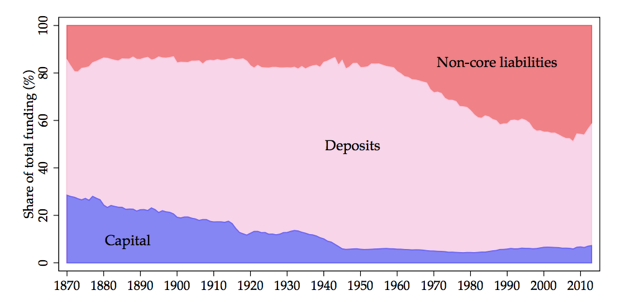
bank leverage rose dramatically between 1870 and the second half of the 20th century. In our sample, the average country’s capital ratio decreased from around 30% capital-to-assets to less than 10% in the post-WW2 period (as shown in Figure 1 below) before fluctuating in a range between 5% and 10% in the past decades. 
Here is the very nice Figure 1. (It shows not just how capital has declined, but how reliance on more run-prone wholesale funding has increased.  The fact that capital used to be 30% is one that we need to reiterate over and over again to the crowd that says 30% capital would bring the world to an end.)
With the facts and regressions,
We find that the capital ratio provides virtually no information about the probability of a systemic financial crisis.
Whether used singly or along with credit, higher capital ratios are associated, if anything, with a higher probability of a crisis.
There used to be a lot more capital, and there used to be a lot more financial crises.

Wow. Now, (this is a good quiz question for a class), before you click the "more" button: Do the facts justify the conclusion? And if not why not?

Well, obviously not, or at least not yet.  Ask the standard  questions of any correlation or forecast in economics: 1) Does it reflect reverse causality -- rich guys drive Mercedes, but driving a Mercedes will not make you rich? 2) What causes the movements in the right hand variable (capital)? They are not random experiments, whims of the God of financial regulation. 3) What other causes of crisis are there (the error term)? Why are they not correlated with the right hand variable (capital?).

The opportunities for reverse causality are rich -- and fully acknowledged. Continuing the above quote:
"... higher capital ratios are associated, if anything, with a higher probability of a crisis. This mechanism is consistent with banks raising capital in response to higher-risk lending choices, rather than as a buffer against a potential systemic crisis event in the economy...."
The paper is even clearer:
"...Such a finding is consistent with a reverse causality mechanism: the more risks the banking sector takes, the more markets and regulators are going to demand banks to hold higher buffers."
It is not surprising that more fire extinguishers predicts either nothing, or more houses burning down. People buy fire extinguishers in fire-prone areas. It is not surprising that airplanes in which pilots wear parachutes are more likely to crash than when pilots don't wear parachutes. It would be an obvious mistake to conclude that buying fire extinguishers and wearing parachutes do not increase house or pilot safety.

Similarly, it is not at all surprising that banks, their depositors, their equity holders, and their regulators all would choose more capital when the chances of a crisis are greater. It is not at all surprising that the probability of a crisis in equilibrium is independent of the amount of capital chosen -- the supply of capital just balances the dangers of crisis. All of this is not at all surprising if adding more capital at any point in time would further reduce the probability of a crisis.

Other effects are just as important. The probability of a crisis also depends on deposit insurance, topnotch risk regulators out there spotting impending crises (hmm), bailouts, and so on. We have arguably traded less capital for more of these other responses -- inefficient, in my view, full of moral hazard, but effective in putting out fires -- so no wonder less capital comes with less (before 2008) or no change in frequency of crisis.

Once again, the authors are completely upfront -- eloquent indeed -- about other effects (error terms correlated with the right hand variable)
Increasing sophistication of financial instruments allowed banks to better hedge against uncertain events. As a result, the business model of banks became safer, implying a lower need for capital buffers (Kroszner (1999), Merton (1995)). Furthermore, diversification and consolidation in banking systems may have reduced the equity buffers required to cope with risk (Saunders and Wilson (1999)). 
Probably the most prominent innovation in this respect was the establishment of a public or quasi-public safety net for the financial sector. Central banks progressively took on the role of lender of last resort, allowing banks to manage short-term liquidity disruptions by borrowing from the central bank through the discount window (Calomiris et al. (2016)). The second main innovation in the 20th century regulatory landscape was the introduction of deposit insurance. Deposit insurance mitigates the risks of self-fulfilling panic-based bank runs (Diamond and Dybvig (1983)); but it may, however, also induce moral hazard if the insurance policy is not fairly priced (Merton (1974)). ... 
A last and arguably more recent extension of guarantees for bank creditors relates to systemically important or “too-big-to-fail” banks. While explicit deposit insurance tends to be limited in most countries to retail deposits up to a certain threshold, large banks may enjoy an implicit guarantee by taxpayers. This implicit guarantee could also help account for the observed increase in aggregate financial sector leverage, although the subsidy is difficult to quantify.
What do the authors do about this? Amazingly, nothing. The paper fully acknowledges reverse causality as a plausible, and perhaps the most plausible interpretation, it outlines a host of other effects correlated with the right hand variable -- and then goes on to do nothing about it.

Regression econometrics these days is exquisitely sensitive to these issues. Paper after paper tries to isolate a "natural experiment" -- an increase in capital unrelated to increased probability of crisis -- or adds differences in differences in differences and a plethora of fixed effects and controls to try to measure the correct cause and effect relationship. This isn't always successful, and throwing out 99% of the data variation is sometimes more confusing than revelatory, and sensitive to just which 99% one throws out, but give them credit for trying. This paper doesn't even try.

Now, perhaps I have mischaracterized the "fact," in the above graph, emphasizing the association of declining capital over time with the frequency of crises. In fact the real evidence in the paper comes from a forecasting regression across time and across countries, of crisis at time t+1 on capital and other variables at time t


So, does this capture the correlation of declining capital ratios over time with the chance of crisis? Or does it capture the correlation of different capital ratios across countries with the country's chance of crisis? (Notice here the severity of crisis is left out, that's the later fact.) Well, both since we have both i and t.

Alas, (p. 16)
"To soak up cross-country heterogeneity, we will include a country fixed effect αi for each of the 17 countries...."
That means they throw out the variation, do countries which on average have higher capital standards than others, on average have fewer crises?  Why in the world would one throw that out? Why are cross-country capital ratios more polluted by endogenous responses than over time capital ratios, and cross country crises more contaminated by correlation with other effects -- amount of mortgage market interference, lender of last resort effectiveness, deposit insurance, etc? If the time series variation is important and exogenous, why exclude the major source of variation, the pre vs. post WWII variation?

in sum, commandment #5 of regression running is: Think about the source of variation in your data.  Don't just randomly throw in country or time fixed effects or split the sample in half.

(Yes, "Pooled models are included in the appendix as well."  But that isn't much help. )

The problem is not with the paper, which is otherwise excellent. The problem is with the paper's headline conclusion -- more capital therefore does not help to reduce the chance of a crisis.

The paper does show, and correctly claims it shows, that capital ratios (in equilibrium) are not helpful in forecasting a crisis.
"our first main finding is that, perhaps counterintuitively, the capital ratio is not a good early-warning indicator, or predictor, of systemic financial crises."
For example, a regulator who wants to stop crises might look at banks piling on capital as a danger signal, the way passengers in my glider are sometimes suspicious when I ask them to put on a parachute. The paper verifies that capital is useless as a forecaster. That is a good, solid point. We might have expected the opposite sign -- more capital, more crisis -- as a useful forecast. But we cannot infer that adding more capital would not reduce the chance of a future crisis.

The paper also makes a nice point about capital, which is not just nice because I agree with it but because the data more clearly support it: More capital means the crisis, when it comes, is less severe. The wearing of parachutes may not forecast safer flights, because people tend to put them on when the flight is more dangerous anyway. But when people do wear parachutes, the outcomes of midair collisions are a lot less severe.
"a more highly levered financial sector at the start of a financial-crisis recession is associated with slower subsequent output growth and a significantly weaker cyclical recovery. Depending on whether bank capital is above or below its historical average, the differences in social output costs are economically sizable. Real GDP per capita five years after the start of the recession is about 5 percentage points higher when banks are well capitalised than when they are not. This difference is displayed in Figure 2."


One can complain about reverse causality here too, but the point is not to whine, the point is to see if there is a really plausible channel, and the strength of the counterargument here seems less strong to me.  It does not seem likely that if people knew an unusually bad recession was ahead, or that the economy was unusually sensitive to financial shocks, they would then equilibrate to less capital.

But why did the authors take a very nice paper that shows that equilibrium (including political and economic equilibrium) doesn't forecast a crisis, and plaster on it a completely unsubstantiated conclusion that more capital would not help to reduce the probability of crisis?

At first I suspected it wasn't their fault. Oped editors frequently pick titles without the authors' knowledge. But it's in the first sentence of the paper abstract.
"Higher capital ratios are unlikely to prevent a financial crisis."
The authors say it again at the end of the oped,
the main role for bank capital appears to lie not so much in eliminating the chances of systemic financial crises, but rather in mitigating their social and economic costs – a distinct but arguably more important benefit.
(My emphasis.) And the paper repeats the point,
we find that macroprudential policy, in the form of higher capital ratios, can lower the costs of a financial crisis even if it cannot prevent it.
history does indeed lend support for a precautionary approach to capital regulation. Its main role appears to lie not so much in eliminating the chances of systemic financial crises, but rather in mitigating their social and economic costs... 
 Why am I making such a fuss?

First, in the sad state of current academic-media interactions, this is sure to be picked up and quoted as "A major study shows that" more capital does not help to prevent crises. (Perhaps in a week or two I'll find time to do some google searches to verify this conjecture.) No, studies that claim a result do not always show a result! This is a classic case. Please, ask what evidence the "study" offers, and is it even vaguely logically coherent!

Second, it is a very instructive case study for students to look at -- how to ruin a great paper by trying to make sexy claims that are not supported by the logic of the paper.

Third, in that vein it allows me to reiterate some important lessons about how to run regressions, lessons that we tend to forget too often.

Spikes

Jon Hartley, writing in Forbes, offers a great graph of the overnight Federal Funds rate,


This graph  mirrors nicely the graph I posted last week, from "Deviations from Covered Interest Rate Parity" by Wenxin Du, Alexander Tepper, and Adrien Verdelhan:


What's going on with these quarter-end spikes?


As Jon, and Wenxin, Alexander, and Adrien explain, European bank regulators assess capital requirements based on a snapshot of balance sheets at the end of the quarter. American regulators assess capital requirements based on an average of the balance sheet over the entire quarter. Thus, at the end of the quarter, European banks unwind positions that require capital, such as FX arbitrage,  for a few days, and stuff the results in assets requiring less capital, like reserves at the Fed.
Even the reverse repo facility's take-up is impacted on quarter-end days, seeing enormous spikes in the amount of assets being put into the facility in month end.
[Reverse repo is how large non-banks, or foreign banks, can invest in interest-paying reserves at the Fed.]

US banks have an opposite incentive (disclaimer, this now is me, not their opinions). If spreads open up at end of quarter, then US banks can take on a huge amount of risk for a few days, and capital requirements only apply to the rest of the quarter.

So the sloshing back and forth of who holds risky positions is a nice little arbitrage of the different regulations for both sides, not just the Europeans. When analyzing financial markets, always remember that for a seller there must be a buyer, and someone is holding the position.

What's the moral of the story? The title of Jon's piece is "Hindering The Fed's Ability To Raise Interest Rates." (Titles are often not under the writer's control.) I'm not convinced. The spikes are in the Fed's band. If the Fed wants to raise the band, I don't see why it can't. US banks seem happy to take the other side of the game (less reserves, more FX for a few days), for a profit.

I see it as one more indication of the problems caused by capital requirements that hinge on capital relative to risk-weighted assets. Assets are hard to measure, risk weights are often wrong.  I prefer capital requirements that measure only bank liabilities:  market value of equity divided by face value of short-term debt, with the limit measuring volatility by equity option prices. (see "A way to fight bank runs—and regulatory complexity" and longer blog post version). This capital ratio uses no regulators or accountants at all to measure assets. And there would be no end of quarter vs. quarter average window dressing.

I see it as an indication of how banks are not very competitive.  This does not happen in competitive markets, especially ones in which nimble new competitors can enter FX or overnight debt markets and remove arbitrages.

I also see it as a success of the Fed's large balance sheet, interest paying reserves, and reverse repo programs. I emphasize that because the reporting out of the Fed is now suggesting a desire to "normalize," i.e. go back to the system that worked so well in 2007, and get rid of these innovations.

Given the regulatory snafu -- and there will be endless regulatory snafus like this in the future -- and the consequent desire for big portfolios to shift around at quarter end, the miracle is that interest rates only move a tenth of a percent or so each quarter. That's because the quantities Jon mentioned can slosh around. European banks can get reserves for a day or two, and then slosh out again. If the overall quantity of reserves were smaller, or fewer institutions were able to get them (if reverse repo were closed), then the price swings would be even larger. It makes the case more strongly for my "reserves for all" proposal, that the Treasury should offer fixed-value, floating-rate debt, just like bank reserves, to anyone, not just "banks."

Update: Jon corrects me. In fact, some of the spikes did fall below the Fed's lower bound. As treasury rates have often been below the lower bound. There is a potential problem with the Fed's ability to lower rates. The Fed pays more interest to banks on excess reserves. Why don't the banks just say "thank you for the present," earn the extra interest on reserves, pay nothing more on deposits, and nothing else changes? Well, competition. Banks should be competing for deposits, and thus raising the deposit rate as the interest they receive on reserves goes up. That this is manifestly not happening tells you something about bank competition. Banks should be trying to sell treasury portfolios to get more reserves, putting downward pressure on treasury prices and raising treasury interest to the interest on excess reserves. Happening sort of, the treasury rate is also often below the lower bound. Money market funds should be selling treasuries and buying reserves through the reverse repo mechanism. As you can see, there is some doubt whether higher interest on reserves will percolate through the economy. (I wrote a whole paper on this). The Fed does not do the one thing that would guarantee this arbitrage -- open up the balance sheet. Bring us treasuries, we give you reserves in any quantity.

In sum, yes, the lower bound on Fed funds rate is breached, as treasuries are often below that bound. There is some issue whether banks are competitive enough to let interest on excess reserves move on to other rates with a fixed balance sheet. But I still don't see the regulatory arbitrage of european banks buying reserves at quarter end as a key mechanism limiting widespread higher interest rates.